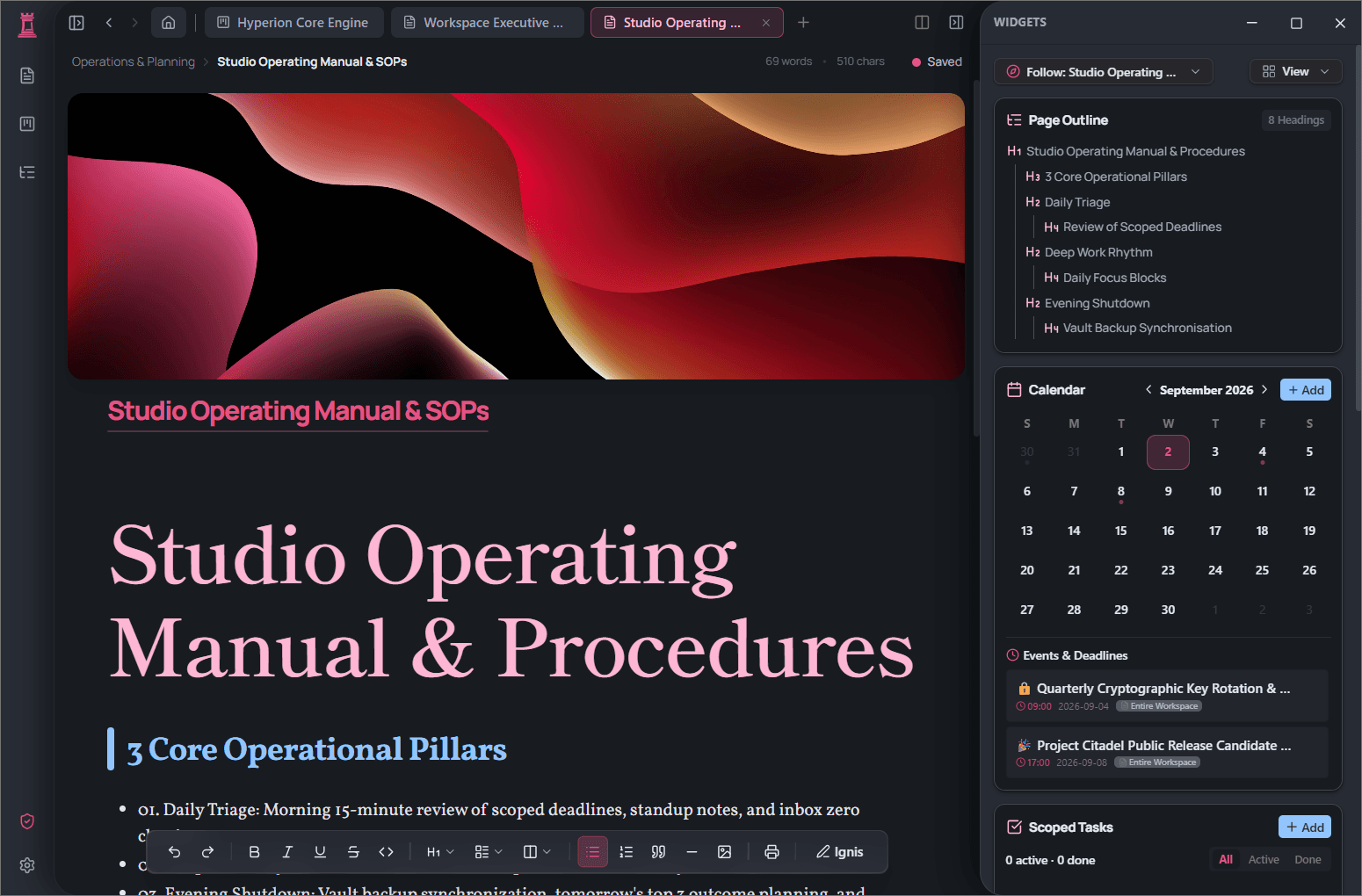
The Premise: The Case for a Local-First Workspace
Subscriptions, Cloud, and Bloat
Over the past decade, software delivery underwent a quiet shift toward the model: You will not own your data, and you will be happy about it.
Mainstream productivity software today runs almost exclusively within Chromium runtimes that sip hundreds of megabytes of memory while completely idle. Running a single research workflow alongside an inactive browser tab can quickly monopolize gigabytes of RAM, inducing battery drain, system stutter, and cognitive friction.
Simultaneously, software fragmentation forces solo operators to juggle distinct subscriptions: one for daily notes, another for Kanban tracking, a third for project scheduling, and separate browser tabs for remote AI assistance. These platforms rarely communicate seamlessly, lock personal data behind proprietary sync servers, and treat offline capabilities as an afterthought. When internet connectivity drops, work grinds to a halt behind conflict-resolution modals and connection timeouts.
Citadel's Core Philosophy
Citadel approaches personal computing through three non-negotiable architectural pillars:
- Absolute Data Ownership: Notes, relational tables, and media assets reside exclusively on physical host storage in open, human-readable formats.
- Native Desktop Performance: Instant cold boots, sub-millisecond local reads, and minimal background resource consumption.
- Verifiable Security & Privacy: Strict air-gapped guarantees where keystrokes, prompt queries, and research databases never cross a network wire.
Designed for Independent Knowledge Work
As a solo developer and university student, I designed Citadel around the exact friction points encountered during high-density academic and technical work:
- Consolidates calendars, project execution boards, research repositories, and contextual intelligence into one coherent, local workspace.
- Bridges the gap between basic Markdown scratchpads and heavyweight presentation tools by offering multi-column page blocks and custom cover banners.
- Replaces standard information overload with flexible scope management, letting users control precisely how much context is presented across each project domain.
The Architecture Pivot: Outgrowing the Prototype
Going Conventional: Next.js and Electron
Like many modern desktop applications, Citadel began as an Electron and Next.js prototype. This stack enabled rapid experimentation with UI layouts, typography pairings, and document interaction patterns. However, once on-device intelligence and multi-document context pipelines were embedded into the runtime, the architecture encountered fundamental friction.
Bundling a full Chromium browser container alongside two local AI models caused the host machine to struggle under intense memory pressure. Even sitting completely idle with no active editing taking place, the prototype held system consumption at 8 GB of RAM and 20% background CPU utilization.
Rebuilding on Tauri v2, Svelte 5, and Rust
To construct an application that respects host hardware, we executed a complete ground-up rewrite, pivoting to Tauri v2, Rust, and Svelte 5:
- Native Webview Integration: Replaced the heavy, bundled Chromium engine with lightweight host-managed webviews to strip away hundreds of megabytes of runtime overhead.
- Compiled Rust Backend: Offloaded file system interactions, cryptographic routines, full-text search indexing, and sidecar model orchestration directly to compiled native threads.
- Fine-Grained Reactivity: Replaced heavy virtual DOM reconciliation with Svelte 5 runes, ensuring UI state mutations execute with near-zero latency.

Build Comparison Metrics
Core Systems & Interface Design
Citadel's structural foundation divides responsibilities across three isolated tiers: the User Interface Layer, the Data Layer, and the Local Intelligence Layer.
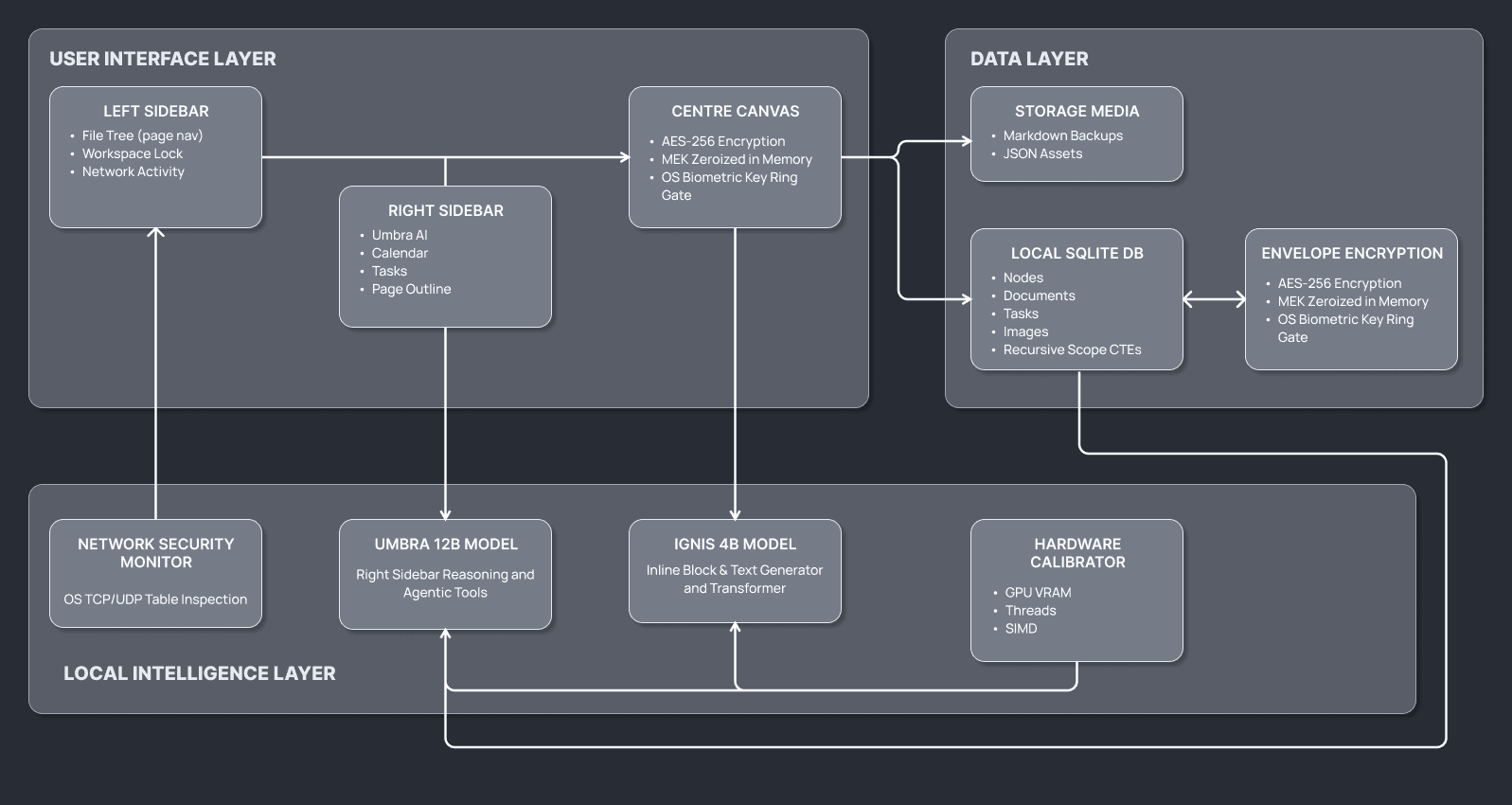
System Architecture using Layers
Spatial Hierarchy
Citadel replaces scattered floating windows with an intentional three-column spatial canvas:
- Left Navigation Sidebar: Manages the hierarchical file tree and workspace locking. Features an active Scope Selector that restricts task lists, document graphs, and AI context retrieval to the boundaries of an active course, research paper, or project. Includes an instant air-gap utility switch to isolate the environment.
- Centre Canvas: The primary focus container, engineered with subtle architectural borders and soft drop shadows. Supports split-screen multitasking across three dedicated view modes:
- Document Canvas: Block-based editing with multi-column configurations and publication-grade cover banners.
- Kanban Boards: Visual workflow progression featuring custom priority tagging and modal inspector sheets.
- List Views: High-density task scheduling categorizing personal, academic, client, and administrative deadlines.
- Right Contextual Sidebar: Houses active document outlines, calendar agendas, aggregated tasks, and the Umbra co-pilot interface.
Typographic Dignity
Visual cadence directly impacts focus during extended writing and research sessions. Citadel balances five deliberate typefaces:
- Manrope: Geometric clarity for navigation items, buttons, and system chrome.
- Vollkorn: Classical serif structure engineered for immersive, fatigue-free long-form reading.
- DM Serif Display: Editorial presence for chapter headers, cover banners, and primary titles.
- Shippori Mincho: Refined East Asian calligraphic balance for quiet contemplative note-taking.
- JetBrains Mono: Crisp syntax formatting and code ligatures for data properties, frontmatter, and security telemetry.
Local Data Pipeline & Zero-Cloud Storage
Every keystroke, state mutation, and structural update in Citadel processes entirely against local storage media, completely bypassing WebSockets, cloud rate limits, and synchronization queues.
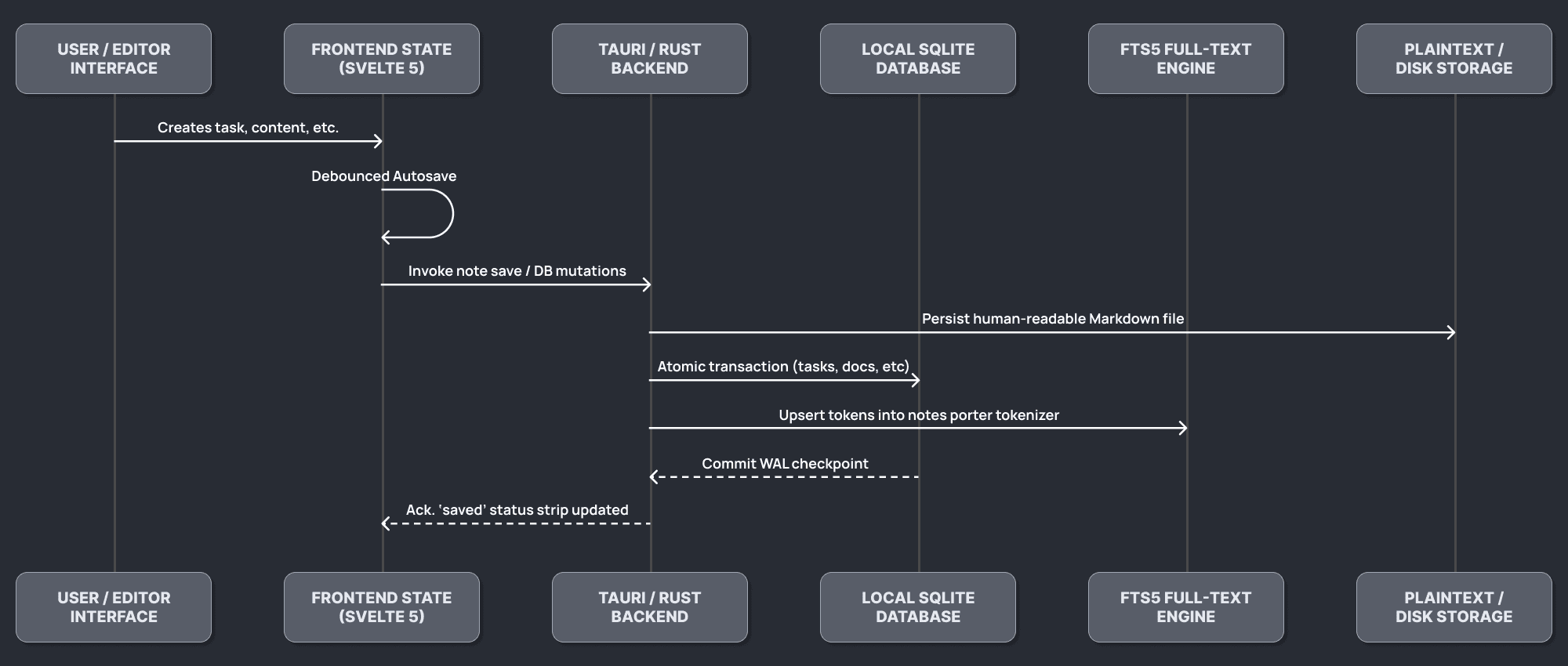
Local Data Pipeline
- Debounced Autosave & Local Dispatch: Svelte 5 captures user mutations and dispatches asynchronous invoke commands to the Tauri Rust core without blocking the main UI thread.
- Structured SQLite Core with WAL: Documents, hierarchical parent-child nodes, tasks, and media metadata write to a local SQLite database configured with Write-Ahead Logging (WAL). Recursive Common Table Expressions (CTEs) resolve deeply nested folder trees in single microsecond passes.
- Plaintext Disk Redundancy: Concurrently with database commits, Citadel mirrors notes into human-readable Markdown files on disk, ensuring permanent data portability outside the application.
- Full-Text Search (FTS5): A native Porter-stemmer SQLite virtual table indexes document content on write, enabling instant token and phrase searches across thousands of records.
- Envelope Encryption & Memory Zeroization: When the workspace is locked, database checkpoints and file archives are wrapped in an AES-256-GCM container. The Master Encryption Key (MEK) is derived via Argon2id (64 MB memory cost), gated by OS biometrics (Windows Hello and macOS Touch ID), and protected by Rust's ZeroizeOnDrop trait to eliminate residual secrets from RAM on exit.
Air-Gapped Intelligence: Ignis & Umbra
Citadel embeds generative AI capabilities natively into the application runtime, rejecting the cloud API model entirely.
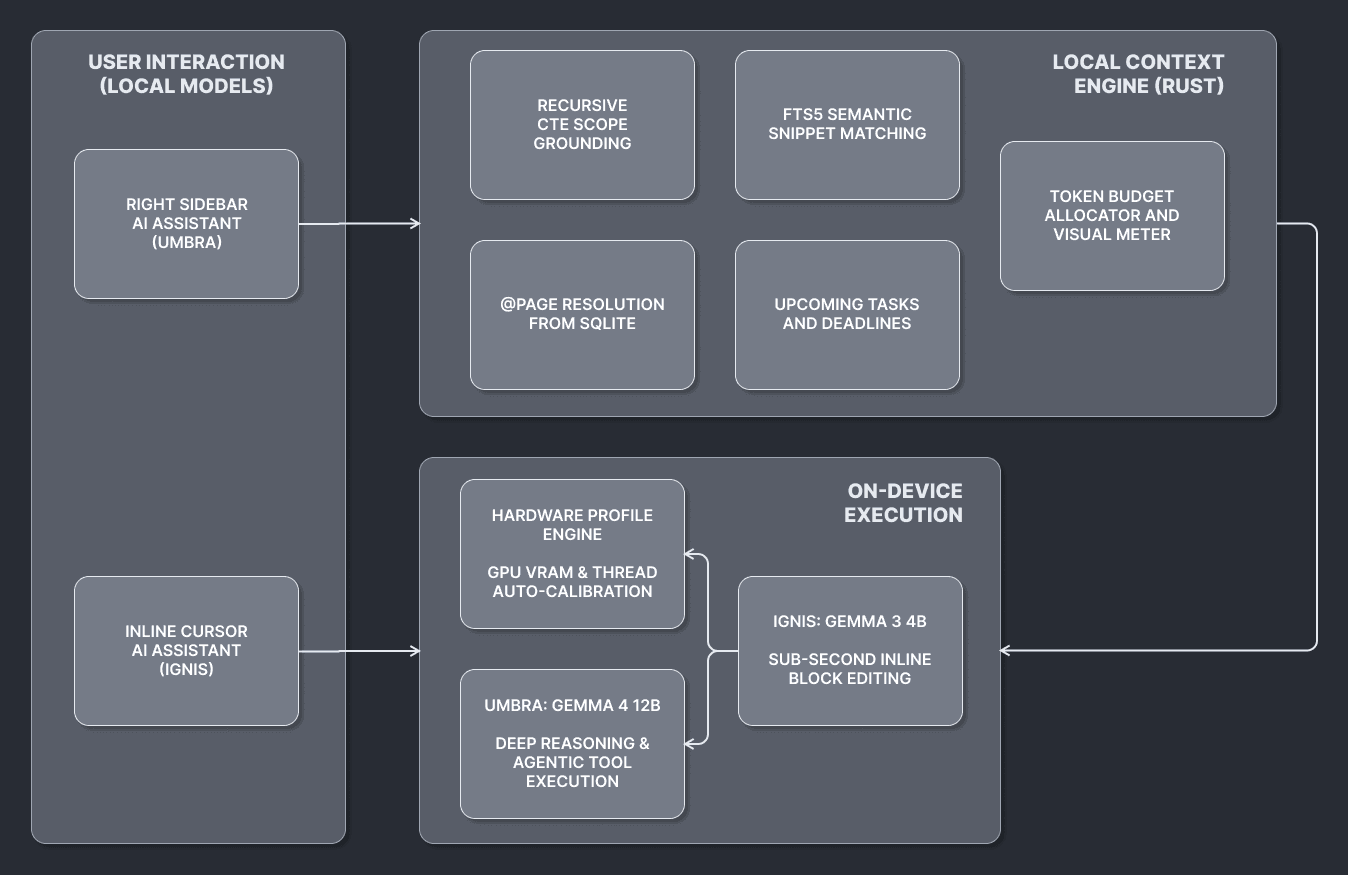
Air-Gapped Intelligence
The Dual-Engine Intelligence Architecture
- Ignis (Google Gemma 3 4B): An optimized, sub-second transformer running directly under the cursor. Ignis handles inline text transformations, summarization, and structural HTML block generation with zero conversational latency.
- Umbra (Google Gemma 4 12B): A deep-reasoning desktop co-pilot residing in the right contextual sidebar. Umbra drives agentic tool execution, scans active project scopes, resolves explicit @page transclusions from SQLite, and correlates upcoming deadlines to synthesize comprehensive execution plans.
Context Management & Execution
- Token Budget Allocator: Rust monitors contextual window distribution in real time, visualizing usage on an integrated meter and optimizing semantic snippet injections.
- Hardware Profile Engine: Automatically balances GPU VRAM allocation, CPU thread binding, and SIMD hardware acceleration based on host system capacity.
- Network Security Monitor: A continuous OS TCP/UDP socket auditor confirms zero open listeners and zero outbound connections, ensuring prompt data never leaves host hardware.
Current Milestone & Beta Roadmap
Citadel has advanced beyond the experimental stage into an optimized, daily-driver environment. The compiled Rust storage engine, spatial UI layouts, cryptographic vaults, and sidecar model orchestrator are fully functional.
Immediate Focus Areas
- Ergonomics & Efficiency: Fine-tuning battery consumption and CPU sleep states during extended writing sessions on laptops.
- Layout Presets: Expanding multi-column editing components and standardized export workflows (PDF, LaTeX, and clean Markdown bundles).
- High-Volume Stress Testing: Validating recursive CTE indexing and FTS5 search speeds across repositories containing tens of thousands of interlinked documents.
If you are looking to reclaim your focus, eliminate recurring software fees, and work inside a private digital sanctuary, visit beckett.vercel.app/citadel to follow development updates and apply for early private beta access.